
RESEARCH
Competitor keyword research for SEO teams
Badgerfly's Research group is competitor keyword research for agencies and SEO teams. Look up what any domain ranks for, turn one keyword into a shortlist, find the keywords competitors rank for and the project does not, and save the ones worth targeting to the project.
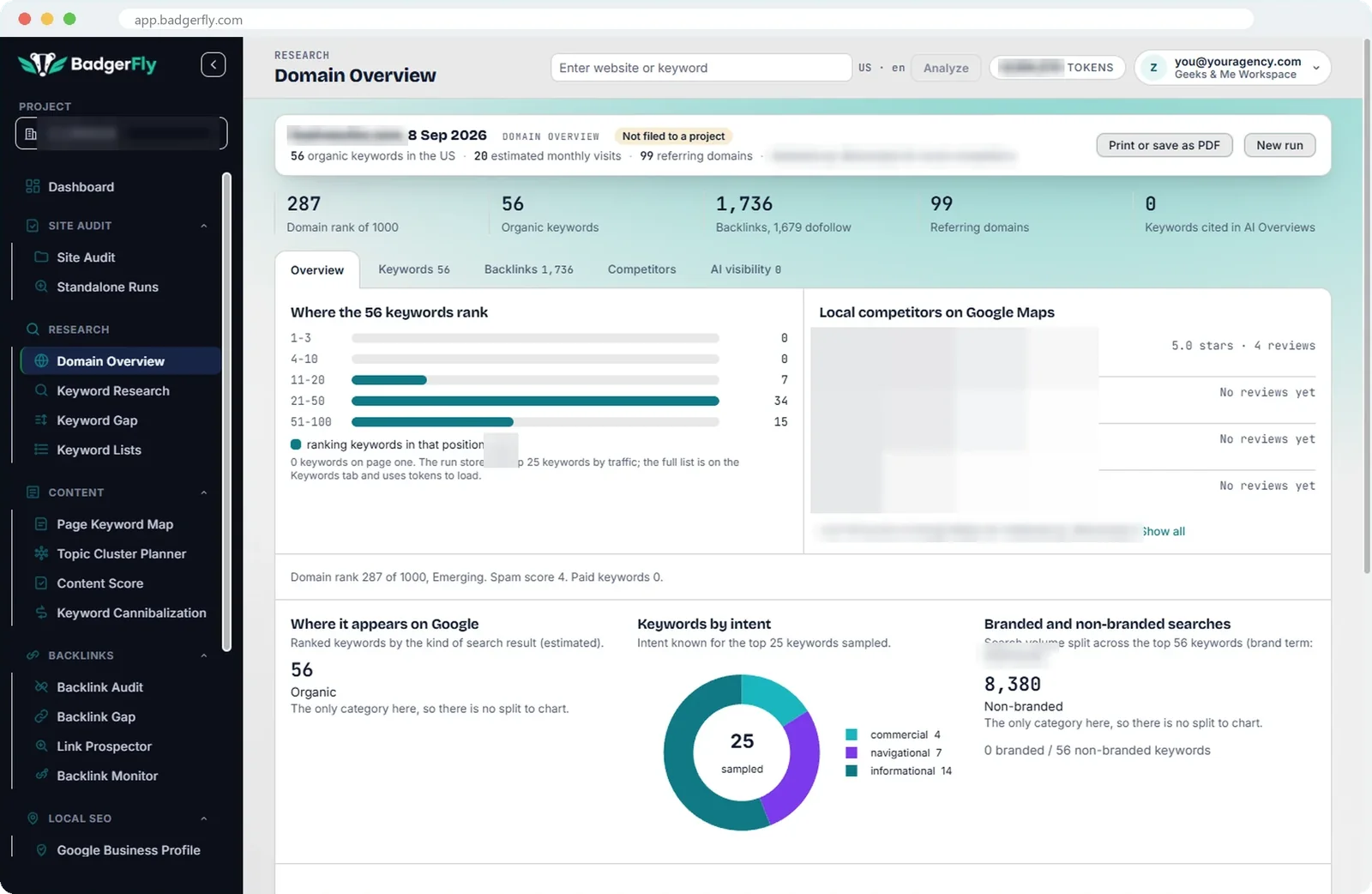
Four modules, one line of work
| Module | What it does |
|---|---|
| Domain Overview | Any domain's search traffic, keywords, links and competitors on one screen. |
| Keyword Research | The searches people make around a keyword, with volume, difficulty and intent. |
| Keyword Gap | The keywords competitors rank for and the project does not. |
| Keyword Lists | Keywords saved from research and planning, kept by project. |
Domain Overview: size up any domain
One lookup profiles a domain: a prospect, a competitor, or a site you have just taken on. It returns:
Traffic is labelled as an estimate, worked out from each keyword's position and search volume. It is not a count of real visits, and the page says so. That makes Domain Overview an honest SEO competitor analysis tool: you can size up a rival in one screen and know which numbers are measured and which are modelled. A lookup is stored, so reopening it later is free; refreshing it pulls new data.
- the domain's rank and how many keywords it appears for in Google's top 100
- estimated monthly visits from search
- backlinks and referring domains, and links over time
- where its keywords rank, and its keywords by intent (learn, find, compare, buy)
- branded against non-branded searches, the part SEO can actually grow
- its competitors, including local competitors on Google Maps
Keyword Research: one idea into a shortlist
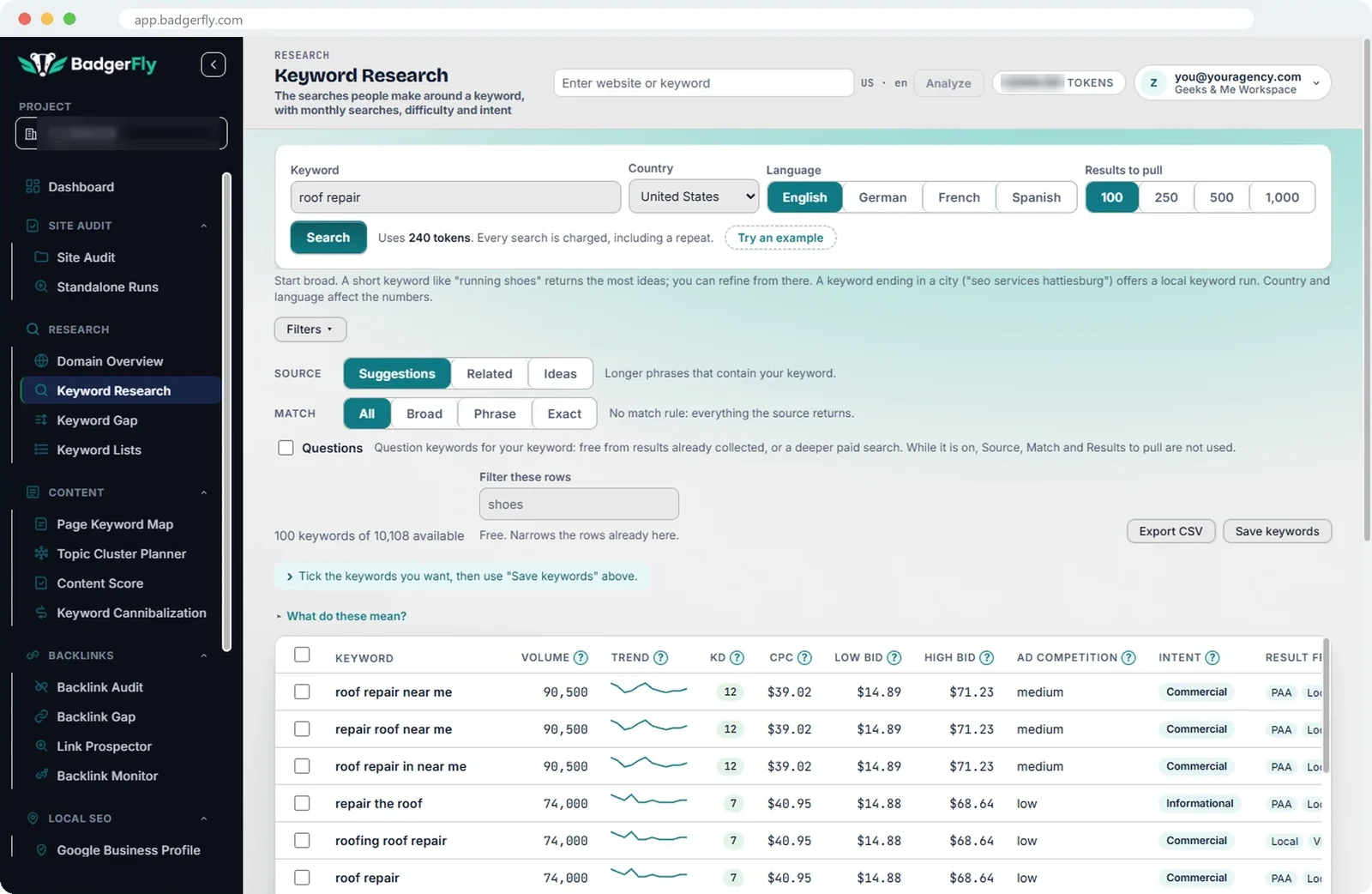
Start from one keyword and get the related searches people make. Each row has:
- monthly searches in the location you choose
- keyword difficulty from 0 to 100 (under 30 is easy, 30 to 60 medium, 60 and over hard)
- cost per click, a sign of commercial value
- intent: learn, find, compare or buy
- a 12-month trend, for spotting seasons
- the special blocks Google shows for the search: an AI answer, a map pack, questions people also ask
Widen the search by suggestions (searches that contain the keyword), related searches, looser ideas or questions. Tick the keywords worth keeping and save them to a list or send them to a tracker. Repeating a search you have already run is usually cached, and a cached result uses no tokens.
Keyword Gap: what competitors rank for and the project does not
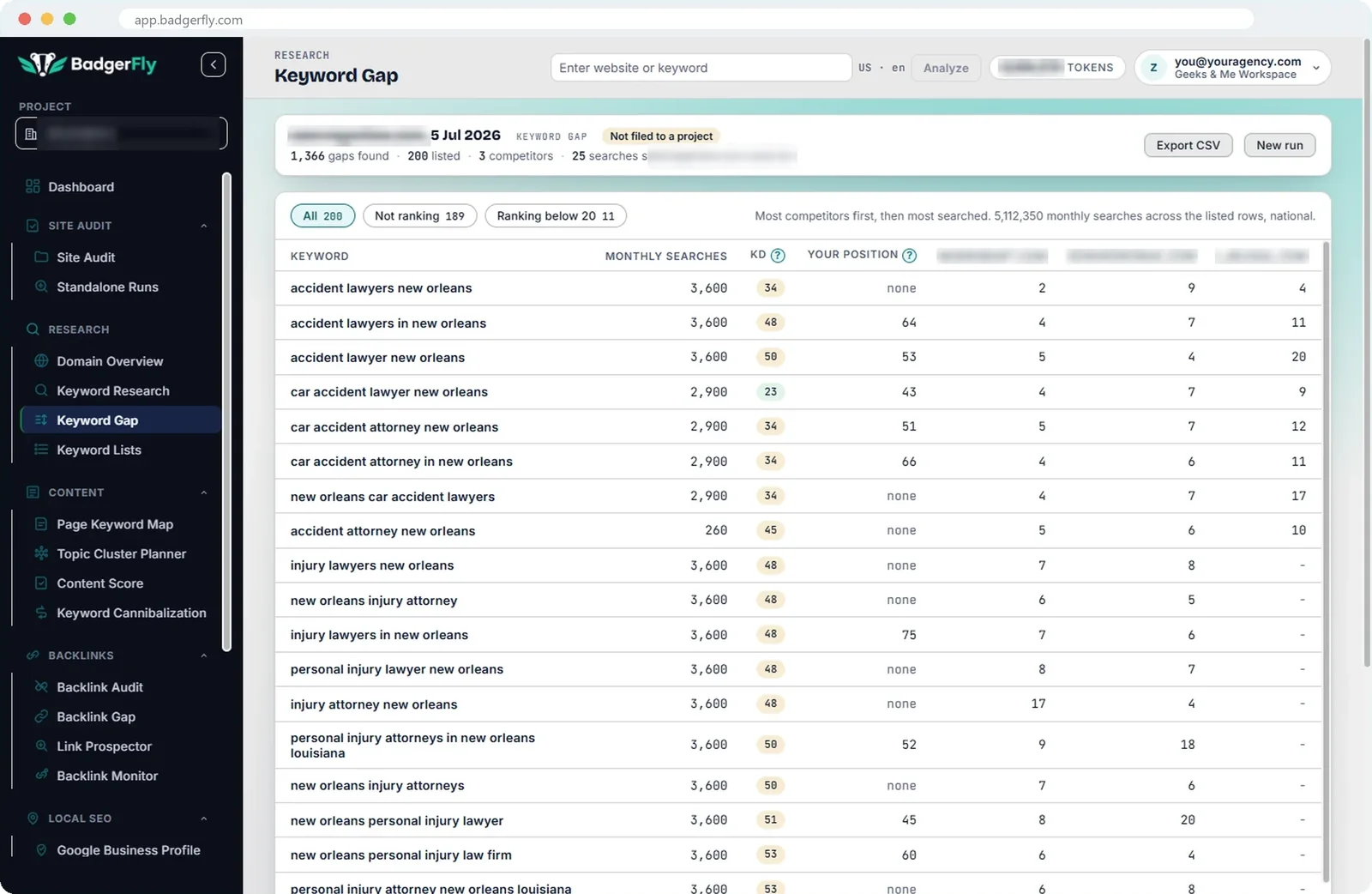
Keyword gap analysis answers a simple question: which searches send traffic to competitors and not to you? Name a few competitor domains and run it. Each gap shows:
- monthly searches and keyword difficulty
- the project's own position, blank if it is not in the top 100
- each competitor's position
A gap is a keyword at least one competitor ranks for where the project does not rank, or ranks far lower. Read together, the list shows what content is missing, in order of opportunity, and the difficulty column tells you which of those pages are worth writing first.
Keyword Lists: research that does not get lost
Keywords you save from Keyword Research and the Topic Cluster Planner land in a named list that belongs to a project. A list can be exported to CSV or sent to a position tracker in one go. The Track all button states the monthly cost of tracking those keywords before you press it, so a long list never turns into a surprise.
A list saved before you picked a project is kept as "not filed under a project" until you file it, so nothing is lost between sessions or tools.
Where research goes next
Research is the start of the work, not the end of it. A shortlist from Keyword Research can become a content plan in the Topic Cluster Planner and Page Keyword Map, a set of tracked keywords in Position Tracker, or a section of the monthly report. Competitors you find in Domain Overview are worth adding to the project profile, which every module reads.
What it costs
Reopening a stored lookup and repeating a cached search cost nothing; new lookups, new searches and tracking from a list are what use tokens. How tokens work
Questions
What is competitor keyword research?
Finding the searches that bring traffic to competing sites, then deciding which of them a site should target. In Badgerfly that is Domain Overview for the big picture and Keyword Gap for the keywords a project is missing.
Is the traffic figure real visits?
No. It is an estimate from each keyword's position and search volume, and it is labelled as one. For a project's real search data, connect Google Search Console.
How is keyword difficulty scored?
From 0 to 100. Under 30 is easy to rank for, 30 to 60 is medium, and 60 and over is hard.
Can I research a domain that is not a project?
Yes. Domain Overview looks up any domain, so you can size up a prospect or a competitor before deciding whether to add it.
PRIVATE BETA
Try Badgerfly on real work
Badgerfly is built and runs end to end, and it is in a private beta for agencies, freelancers and in-house SEO teams. Beta accounts are free, with a monthly allowance for real audits, research and tracking. All we ask is honest feedback.